













Robinson Cole LLP
High Contrast Mode

Kayla O’Leary Daly is an Intellectual Property + Technology transactions associate. Kayla assists clients with a wide variety of intellectual property and technology counseling, prosecution and transactional matters, including intellectual property development and license agreements, software as a service (SaaS) agreements, data license agreements, outsourcing and services agreements, and various other commercial contracts that include intellectual property and/or technology components.

She has experience servicing clients across a broad range of industries and sectors, including technology, consumer products, consulting, manufacturing, healthcare, and food and beverage. Kayla also has experience assisting with and advising on mergers and acquisitions where intellectual property and/or technology assets are pertinent to the deal’s value. She is a member of our firm's Intellectual Property + Technology and Business Transactions groups.

Intellectual Property and Technology Transactions

Kayla’s practice involves advising clients on the development, protection, licensing and commercialization of intellectual property and technology. Kayla has extensive experience drafting and negotiating data license agreements and advising clients regarding the licensing, development, and ownership of data rights.

In connection with technology development, she assists clients with a wide variety of agreements necessary to protect, maintain and exploit technology. For example, Kayla has aided clients with all aspects of a new technology product launch, including drafting development agreements, supply and manufacturing agreements, terms and conditions of product purchase, product support and maintenance agreements, and end user license agreements for software products.

Kayla also represents clients licensing software and outsourcing IT services by advising on and negotiating software license, master IT services, cloud services and software as a service (SaaS) agreements.

Business Transactions

Kayla has experience assisting companies with various aspects of their general commercial contracting needs, including domestic and international distribution and manufacturing agreements, master services and other vendor agreements, employee and independent contractor confidentiality and inventions assignment agreements, sales agreements and purchase contracts, non-disclosure agreements, reseller agreements, sales representative agreements, consulting agreements, minimum advertised price policies, and website terms of use.

Trademark Prosecution

Kayla assists clients with brand management including clearance, prosecution, maintenance and enforcement of trademark registrations and rights worldwide. Kayla also aids clients with resolution of ownership and rights disputes including assisting with U.S. Patent and Trademark Office opposition and cancellation proceedings.

  • Boston University School of Law (Juris Doctor)
    • Journal of Science and Technology Law
  • University of Connecticut (Bachelors, magna cum laude)
    • B.S., Business Marketing
    • New England Scholar
    • Samuel L. Schrager Business Law Scholarship

  • State of Connecticut

Selected as a Rising Star to the Connecticut Super Lawyers list for 2024 and 2025

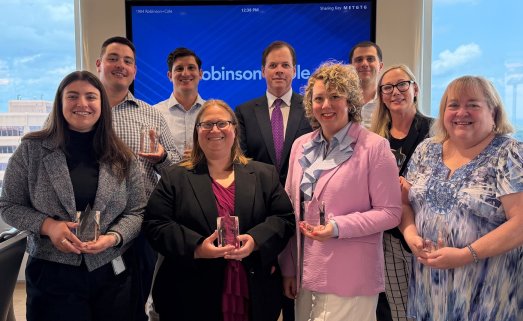
Robinson+Cole Mentor of the Year, 2022

Connecticut Bar Association
Intellectual Property Section, Executive and Legislative Committees

Experience


Represented MD Labs in First Circuit Victory for Clinical Lab in False Claims Act Appeal

Successfully represented MD Labs and its owners in defending against False Claims Act allegations in U.S. ex rel. Omni Healthcare Inc. v. MD Spine Solutions LLC et al., securing summary judgment in the District of Massachusetts and a unanimous affirmation by the U.S. Court of Appeals for the First Circuit. This landmark decision clarified that clinical laboratories may rely on doctor’s orders to show that the test is “reasonable and necessary” and confirmed that commissions to independent contractors are not per se illegal — setting an important precedent for clinical laboratories nationwide.

Read More
Represented MD Labs in First Circuit Victory for Clinical Lab in False Claims Act Appeal

Represented FactSet in Investment in Series B Preferred Stock in Aidentified

Represented FactSet, a global financial digital platform and enterprise solutions provider, in connection with its $12.5 million investment in Series B Preferred Stock of Aidentified, Inc., a leading AI-powered prospecting and relationship intelligence platform for financial services professionals that provides financial advisors, marketing teams, and other sales professionals with tools to identify, qualify, and convert new client relationships. The investment will fund further technological developments, dramatically accelerate prospecting and business development, and grow Aidentified’s team as its client adoption increases.

Read More

GrowGen Aquisition of Agron.io

Represented GrowGeneration Corp. (GrowGen), an owner and operator of a network of specialty hydroponic gardening stores, advising on its acquisition of Agron.io, a leading wholesale agriculture platform powered by proprietary enterprise resource planning (ERP) technology that allows commercial growers to manage their purchasing and logistics in one platform. With this acquisition, announced on March 22, 2021, Agron.io Powered by GrowGeneration continues to be a one-stop destination for GrowGeneration's growing roster of commercial clients across the U.S.

Read More


Publications


November 11, 2025

Negotiating with Big Tech: Top 3 Issues To Watch Out For

Industry Today

Focus on negotiating key issues rather than attempting to revise the entire agreement. Companies of all shapes and sizes, from start-ups to major corporations and across all industries, deal with major tech companies in some capacity. Your company is engaging with big tech to license the rights to use a variety of key solutions, which are critical to the smooth operation of your business. Often the pricing and nature of the solutions give the tech company more control over the agreement terms. As a result, your company will typically have to focus on key issues rather than attempting to significantly revise the entire agreement. This article identifies three key issues to be on the lookout for in these agreements and provides tips on the terms worth fighting for. The Right to Terminate A number one priority in negotiating any agreement should be the ability to get out of the relationship if it takes a turn for the worse. Despite what the rest of the contract terms state, you never know what could happen – the vendor could experience a major data breach, go bankrupt, or just stop providing the same caliber of services to you for whatever reason. Your company may want to stop the relationship (or at least have the leverage provided by the option to stop the relationship) and avoid having litigation as the only path forward to either correct or end the relationship. Most big tech companies will not agree to a right for you terminate for convenience at any time, however, there are other ways you may better position yourself to be able to end the agreement, if necessary. Especially for subscription-model license agreements with tech companies, it is common for the term of the subscription to automatically renew. This means that if you subscribe for a one-year term, the subscription will automatically renew at the end of that year (sometimes at the vendor’s then-current rates, which would likely be higher than what you originally agreed to), unless you provide notice within a certain amount of time before the expiration of the initial term. It is not unreasonable to push back on this and request for the agreement to renew only if you elect for renewal prior to the expiration of the initial term. There are also other termination rights you can try to work in that are not as aggressive as a right to terminate for convenience. For instance, you can negotiate for the inclusion of a termination right in the following circumstances: If the vendor upgrades or otherwise changes their software in a way that materially degrades its usefulness for your company; If the vendor is unable to provide the services for a period of time because of some unforeseeable circumstance out of its control (often referred to in contracts as a “force majeure event”); or If the service is in a downgraded state or completely unavailable to you for certain periods of time. At a bare minimum, you can request are the right to terminate if the vendor breaches the agreement or goes bankrupt, which are market standard terms. Rights and Restrictions Regarding Your Data Given the nature of the products and services they are providing, many tech companies will have access to significant amounts of your data and sometimes very sensitive data. As data continues to become more valuable (especially with advancements in artificial intelligence), we are seeing tech companies increasingly try to broaden their rights to use your data in these agreements. There is a delicate balance between ensuring the vendor has the appropriate rights they need to use your data in order to provide the contracted-for product or services, and ensuring that the vendor does not use your data for additional or unnecessary purposes. It is common to see language in a tech vendor’s agreement stating that they have the right to collect, anonymize, and aggregate your data (which can include both the data you input into their software or usage data they gather based on how you interact with their software) and use such data in a broad context, e.g., in order to improve their products and services, to train artificial intelligence, or for other commercial purposes. You can push back on this and may want to consider doing so especially if the language goes as far to say that the vendor owns that data. Push back can be “right sized” to reflect the circumstances and the amount of leverage you have and, therefore, might include rights to use only some of your data or limitations in the types of permitted uses. Many vendors will claim that their software automatically collects, gathers or tracks such information and that there is no way to “turn off” that feature for just one client. If that is the case, then you may need to assess the sensitivity of the information the vendor would have access to and the risks associated with their access and use. If the risk is too great, you may need to walk away from that vendor. Recourse for Breach Lastly, it is important that you have appropriate safeguards in place and a right to recourse for a possible breach so that you can either force vendor’s performance or collect damages for non-performance. Here are some key clauses in a tech agreement where such recourse can be incorporated: Representations and Warranties – Standard representations from a tech vendor that may be appropriate to include are: (1) that the software will function in accordance with any agreed upon specifications; (2) that it will be provided in compliance with laws; (3) that it will not contain viruses; and (4) and that your use of it will not infringe upon any third party’s intellectual property rights. Indemnification – Depending on how much of your data the tech vendor is processing or otherwise has access to, and how sensitive that data is, you may want to try to include data breaches among the claims covered by indemnification. Intellectual property infringement is also important to have covered by indemnification, and this is generally market standard so you can reasonably push for it. You can also consider other “fixes” to infringement, such as requiring the vendor to modify the software so that it is no longer infringing, obtain a license so you can still use it, or provide you with a refund. Limitations on Liability – Pick your battles carefully when it comes to carve-outs on the limitations to liability because vendors will likely push back aggressively on any proposed changes to these terms. Negotiation of the limitations on liability will be related to what you are able to negotiate for the representations and warranties, as well as indemnification. Ideally, you want breaches of representations and indemnification claims to be carved out of limitations on liability; at a minimum, it is market standard for the carve-outs to limitations on liability to include the vendor’s gross negligence or willful misconduct. The above summaries only scratch the surface on each topic. There are, of course, other elements of tech agreements that are important to closely consider. When you have limited leverage negotiating with bigger companies and you have to pick your battles, the three issues discussed here are important to keep in mind.

Intellectual Property + Technology Newsletter teaser
Q4 2021

Intellectual Property + Technology Newsletter

November 17, 2021

Transformation or Derivation: Modern Trends in the Fair Use Doctrine from Software to Photography

IPWatchdog

The article discusses how the “Fair Use” doctrine has evolved as technology and the way in which people use copyrighted works has advanced. Through an analysis of recent decisions from the U.S. Supreme Court and U.S. Court of Appeals for the Second Circuit, which have resulted in some conflicting guidance, the authors concluded that “[G]iven the emerging trends in the law, it is important for defense counsel to identify and pursue potential fair-use defenses early in a copyright litigation, even outside the traditional areas of commentary, criticism, teaching, news reporting, scholarship, and research.” View the article.

November 11, 2025

Negotiating with Big Tech: Top 3 Issues To Watch Out For

Industry Today

Focus on negotiating key issues rather than attempting to revise the entire agreement. Companies of all shapes and sizes, from start-ups to major corporations and across all industries, deal with major tech companies in some capacity. Your company is engaging with big tech to license the rights to use a variety of key solutions, which are critical to the smooth operation of your business. Often the pricing and nature of the solutions give the tech company more control over the agreement terms. As a result, your company will typically have to focus on key issues rather than attempting to significantly revise the entire agreement. This article identifies three key issues to be on the lookout for in these agreements and provides tips on the terms worth fighting for. The Right to Terminate A number one priority in negotiating any agreement should be the ability to get out of the relationship if it takes a turn for the worse. Despite what the rest of the contract terms state, you never know what could happen – the vendor could experience a major data breach, go bankrupt, or just stop providing the same caliber of services to you for whatever reason. Your company may want to stop the relationship (or at least have the leverage provided by the option to stop the relationship) and avoid having litigation as the only path forward to either correct or end the relationship. Most big tech companies will not agree to a right for you terminate for convenience at any time, however, there are other ways you may better position yourself to be able to end the agreement, if necessary. Especially for subscription-model license agreements with tech companies, it is common for the term of the subscription to automatically renew. This means that if you subscribe for a one-year term, the subscription will automatically renew at the end of that year (sometimes at the vendor’s then-current rates, which would likely be higher than what you originally agreed to), unless you provide notice within a certain amount of time before the expiration of the initial term. It is not unreasonable to push back on this and request for the agreement to renew only if you elect for renewal prior to the expiration of the initial term. There are also other termination rights you can try to work in that are not as aggressive as a right to terminate for convenience. For instance, you can negotiate for the inclusion of a termination right in the following circumstances: If the vendor upgrades or otherwise changes their software in a way that materially degrades its usefulness for your company; If the vendor is unable to provide the services for a period of time because of some unforeseeable circumstance out of its control (often referred to in contracts as a “force majeure event”); or If the service is in a downgraded state or completely unavailable to you for certain periods of time. At a bare minimum, you can request are the right to terminate if the vendor breaches the agreement or goes bankrupt, which are market standard terms. Rights and Restrictions Regarding Your Data Given the nature of the products and services they are providing, many tech companies will have access to significant amounts of your data and sometimes very sensitive data. As data continues to become more valuable (especially with advancements in artificial intelligence), we are seeing tech companies increasingly try to broaden their rights to use your data in these agreements. There is a delicate balance between ensuring the vendor has the appropriate rights they need to use your data in order to provide the contracted-for product or services, and ensuring that the vendor does not use your data for additional or unnecessary purposes. It is common to see language in a tech vendor’s agreement stating that they have the right to collect, anonymize, and aggregate your data (which can include both the data you input into their software or usage data they gather based on how you interact with their software) and use such data in a broad context, e.g., in order to improve their products and services, to train artificial intelligence, or for other commercial purposes. You can push back on this and may want to consider doing so especially if the language goes as far to say that the vendor owns that data. Push back can be “right sized” to reflect the circumstances and the amount of leverage you have and, therefore, might include rights to use only some of your data or limitations in the types of permitted uses. Many vendors will claim that their software automatically collects, gathers or tracks such information and that there is no way to “turn off” that feature for just one client. If that is the case, then you may need to assess the sensitivity of the information the vendor would have access to and the risks associated with their access and use. If the risk is too great, you may need to walk away from that vendor. Recourse for Breach Lastly, it is important that you have appropriate safeguards in place and a right to recourse for a possible breach so that you can either force vendor’s performance or collect damages for non-performance. Here are some key clauses in a tech agreement where such recourse can be incorporated: Representations and Warranties – Standard representations from a tech vendor that may be appropriate to include are: (1) that the software will function in accordance with any agreed upon specifications; (2) that it will be provided in compliance with laws; (3) that it will not contain viruses; and (4) and that your use of it will not infringe upon any third party’s intellectual property rights. Indemnification – Depending on how much of your data the tech vendor is processing or otherwise has access to, and how sensitive that data is, you may want to try to include data breaches among the claims covered by indemnification. Intellectual property infringement is also important to have covered by indemnification, and this is generally market standard so you can reasonably push for it. You can also consider other “fixes” to infringement, such as requiring the vendor to modify the software so that it is no longer infringing, obtain a license so you can still use it, or provide you with a refund. Limitations on Liability – Pick your battles carefully when it comes to carve-outs on the limitations to liability because vendors will likely push back aggressively on any proposed changes to these terms. Negotiation of the limitations on liability will be related to what you are able to negotiate for the representations and warranties, as well as indemnification. Ideally, you want breaches of representations and indemnification claims to be carved out of limitations on liability; at a minimum, it is market standard for the carve-outs to limitations on liability to include the vendor’s gross negligence or willful misconduct. The above summaries only scratch the surface on each topic. There are, of course, other elements of tech agreements that are important to closely consider. When you have limited leverage negotiating with bigger companies and you have to pick your battles, the three issues discussed here are important to keep in mind.

Intellectual Property + Technology Newsletter teaser
Q4 2021

Intellectual Property + Technology Newsletter

November 17, 2021

Transformation or Derivation: Modern Trends in the Fair Use Doctrine from Software to Photography

IPWatchdog

The article discusses how the “Fair Use” doctrine has evolved as technology and the way in which people use copyrighted works has advanced. Through an analysis of recent decisions from the U.S. Supreme Court and U.S. Court of Appeals for the Second Circuit, which have resulted in some conflicting guidance, the authors concluded that “[G]iven the emerging trends in the law, it is important for defense counsel to identify and pursue potential fair-use defenses early in a copyright litigation, even outside the traditional areas of commentary, criticism, teaching, news reporting, scholarship, and research.” View the article.

IP + T: Intelligence teaser
Q1 2021

IP + T: Intelligence

IP+T Group: Out + About teaser
December 2020

IP+T Group: Out + About

IP+T: Intelligence teaser
Q2 2020

IP+T: Intelligence


IP + T: Intelligence teaser
Q1 2021

IP + T: Intelligence

IP+T Group: Out + About teaser
December 2020

IP+T Group: Out + About

IP+T: Intelligence teaser
Q2 2020

IP+T: Intelligence

Events


Past

Ethical Practices for Communications with Clients, Opposing Parties, and the USPTO

Dec 1 2022
A Connecticut Bar Association roundtable discussion hosted by the CBA Intellectual Property Section
Past

NFTs, Fine Art, and Software: The Many Faces of Copyright Fair Use

Mar 8 2022
CT Bar Association's Intellectual Property Section
Past

Ethical Practices for Communications with Clients, Opposing Parties, and the USPTO

Dec 1 2022
A Connecticut Bar Association roundtable discussion hosted by the CBA Intellectual Property Section
Past

NFTs, Fine Art, and Software: The Many Faces of Copyright Fair Use

Mar 8 2022
CT Bar Association's Intellectual Property Section
Past

Food’NBev Connect

March and April 2022
Presented to Food'NBev
Past

Tata Consumer Products

February 2022
Presented to Tata Consumer Products
Past

Intellectual Property: 2020 SCOTUS Decisions and Other Landmark Cases

Jan 19 2021
Connecticut Bar Association
Past

Food’NBev Connect

March and April 2022
Presented to Food'NBev
Past

Tata Consumer Products

February 2022
Presented to Tata Consumer Products
Past

Intellectual Property: 2020 SCOTUS Decisions and Other Landmark Cases

Jan 19 2021
Connecticut Bar Association

News


November 17, 2025

Kayla O’Leary Daly Discusses Three Key Issues When Negotiating Big Tech Agreements

Intellectual Property + Technology lawyer Kayla O’Leary Daly discussed three key issues to focus on when negotiating agreements with big tech providers in her article, “Negotiating with Big Tech: Top 3 Issues To Watch Out For,” published in Industry Today, November 11, 2025. Kayla suggests the right to terminate, rights and restrictions regarding your data, and recourse for breach are among the most important contract elements to negotiate. “Often the pricing and nature of the solutions give the tech company more control over the agreement terms. As a result, your company will typically have to focus on key issues rather than attempting to significantly revise the entire agreement… When you have limited leverage negotiating with bigger companies and you have to pick your battles, the three issues discussed here are important to keep in mind.” Read the article.

Industry Today
November 6, 2025

Robinson+Cole Commends 62 Attorneys Recognized in 2025 Super Lawyers®

Recognition spans key regions and highlights the firm’s seasoned practitioners and emerging leaders in many business transactions and litigation practices
Robinson+Cole Commends 62 Attorneys Recognized in 2025 <i>Super Lawyers</i>® teaser
October 31, 2024

Robinson+Cole Lawyers Recognized in 2024 Super Lawyers®

Thomson Reuters
Robinson+Cole Lawyers Recognized in 2024 <i>Super Lawyers</i>® teaser
November 17, 2025

Kayla O’Leary Daly Discusses Three Key Issues When Negotiating Big Tech Agreements

Intellectual Property + Technology lawyer Kayla O’Leary Daly discussed three key issues to focus on when negotiating agreements with big tech providers in her article, “Negotiating with Big Tech: Top 3 Issues To Watch Out For,” published in Industry Today, November 11, 2025. Kayla suggests the right to terminate, rights and restrictions regarding your data, and recourse for breach are among the most important contract elements to negotiate. “Often the pricing and nature of the solutions give the tech company more control over the agreement terms. As a result, your company will typically have to focus on key issues rather than attempting to significantly revise the entire agreement… When you have limited leverage negotiating with bigger companies and you have to pick your battles, the three issues discussed here are important to keep in mind.” Read the article.

Industry Today
November 6, 2025

Robinson+Cole Commends 62 Attorneys Recognized in 2025 Super Lawyers®

Recognition spans key regions and highlights the firm’s seasoned practitioners and emerging leaders in many business transactions and litigation practices
Robinson+Cole Commends 62 Attorneys Recognized in 2025 <i>Super Lawyers</i>® teaser
October 31, 2024

Robinson+Cole Lawyers Recognized in 2024 Super Lawyers®

Thomson Reuters
Robinson+Cole Lawyers Recognized in 2024 <i>Super Lawyers</i>® teaser
July 3, 2024

Robinson+Cole Represents FactSet in Investment in Series B Preferred Stock in Aidentified

April 30, 2024

Robinson+Cole Represents Gate Worldwide in Sale of Nomadix and GlobalReach to ASSA ABLOY

August 2, 2022

Robinson+Cole Presents Annual Awards for Outstanding Contributions

March 31, 2021

Capital Markets + Securities Team Represents GrowGeneration Corp. in Recent Acquisitions

February 11, 2021

Capital Markets + Securities Team Represents GrowGeneration Corp. in Significant Transactions

January 14, 2021

Jackie Scheib and Kayla O'Leary Author CT Chapter in INTA Member Publication

U.S. State Trademark and Unfair Competition Law

July 3, 2024

Robinson+Cole Represents FactSet in Investment in Series B Preferred Stock in Aidentified

April 30, 2024

Robinson+Cole Represents Gate Worldwide in Sale of Nomadix and GlobalReach to ASSA ABLOY

August 2, 2022

Robinson+Cole Presents Annual Awards for Outstanding Contributions

March 31, 2021

Capital Markets + Securities Team Represents GrowGeneration Corp. in Recent Acquisitions

February 11, 2021

Capital Markets + Securities Team Represents GrowGeneration Corp. in Significant Transactions

January 14, 2021

Jackie Scheib and Kayla O'Leary Author CT Chapter in INTA Member Publication

U.S. State Trademark and Unfair Competition Law